


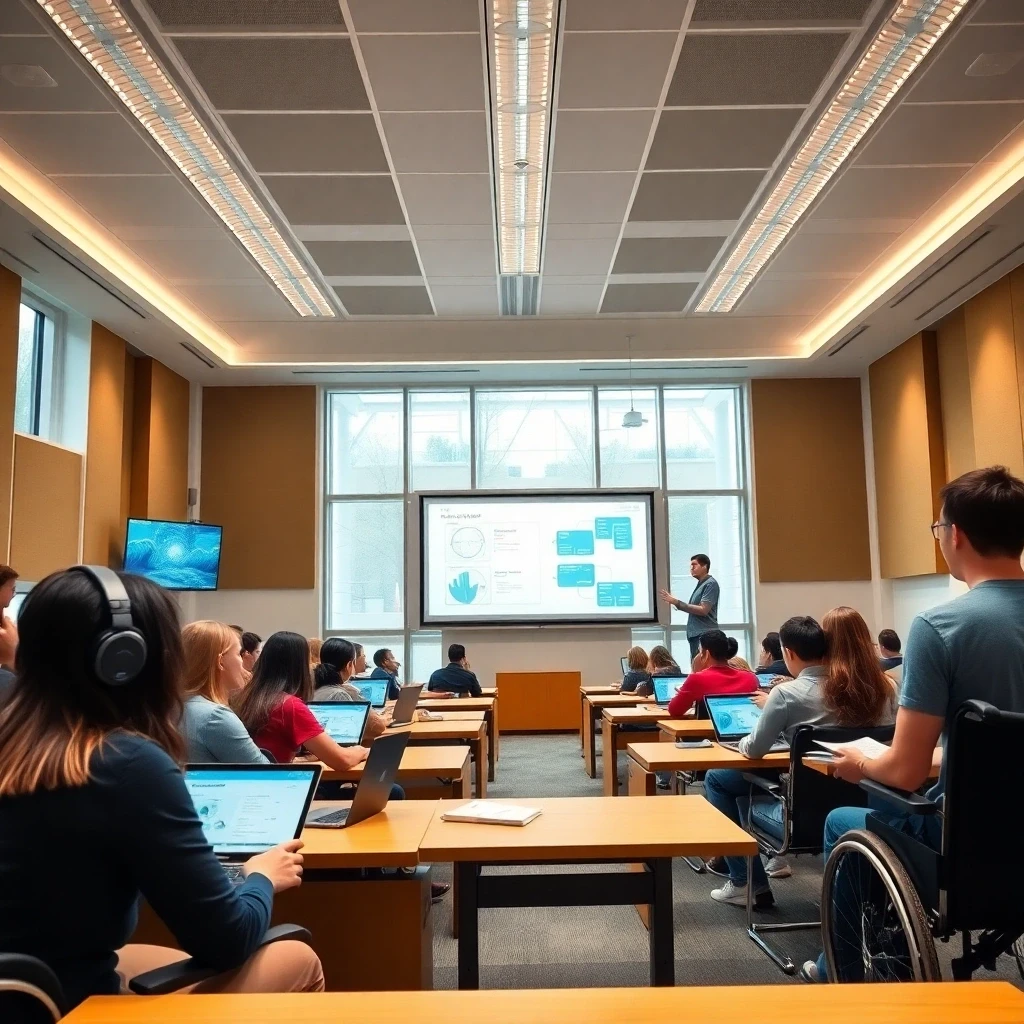
Are your teaching methods unintentionally excluding students? Universal design for learning in higher education flips the script on traditional classroom approaches. Instead of forcing diverse learners to adapt to rigid teaching methods, it challenges YOU to design flexible curricula that work for everyone from the start.
In other words, Universal Design for Learning shifts the focus from learner deficits to curriculum design. The result? Enhanced outcomes for ALL students, reduced reliance on reactive accommodations, and a future-proof teaching practise.
What is Universal Design for Learning (UDL)?
Universal Design for Learning in higher education traces its roots to architecture. Ron Mace at North Carolina State University originally developed universal design principles to create products and environments accessible to all people whilst meeting Americans with Disabilities Act requirements 1. CAST, founded in 1984 as the Centre for Applied Special Technology, adapted this architectural concept into an educational framework 1.
Origins and core philosophy
CAST grounded UDL in the developmental psychology work of Lev Vygotsky, identifying three brain networks that align with his prerequisites for learning 1. The affective network manages engagement with learning tasks. The recognition network handles recognition of information to be learned. The strategic network governs application of strategies to process information 1.
Each brain comprises billions of interconnected neurons forming unique pathways 2. Like fingerprints, no two brains are identical 2. Given that individual brains receive and process information differently, curriculum design must accommodate these variations 1.
The CAST UDL Guidelines serve as concrete suggestions rooted in scientific insights into how humans learn 3. On July 30th, 2024, CAST released UDL Guidelines 3.0, responding to calls from practitioners and researchers to address critical barriers rooted in biases and systems of exclusion for learners with and without disabilities 3. These guidelines support educators, curriculum developers, instructional designers, researchers, and parents in applying the framework to practise 3.
The shift from learner deficit to curriculum design
UDL fundamentally changes the question from ‘What’s wrong with the student?’ to ‘What’s wrong with the learning environment?’ 3. Barriers to learning exist in the design of curricular goals, assessments, methods, and materials, not within students themselves 3. In this way, the learning environment can be ‘abled’ or ‘dis-abled’ 3.
The framework assumes that barriers to learning stem from environmental design rather than student deficiencies 3. Physical access to classrooms represented an initial step towards accessibility, but inclusion required more than physical presence. Students with disabilities needed equal access to the general curriculum and genuine opportunities to benefit from what schools offered 1.
UDL aims to change the design of the environment rather than situate the problem as a perceived deficit within the learner 4. When environments are intentionally designed to reduce barriers, every learner can engage in rigorous, meaningful learning 4.
Building learner agency and autonomy
The ultimate goal of UDL centres on learner agency: the capacity to actively participate in making choices that serve learning goals 4. The framework seeks to develop ‘expert learners’ who demonstrate six interconnected characteristics 43.
Expert learners are purposeful, acting in ways that are personally and socially meaningful with internalised self-efficacy. They are reflective, demonstrating self-awareness and metacognition to identify internal motivations and external influences that support learning 4. Equally, they are resourceful, understanding and applying assets, strengths, and linguistic and cultural capital 4.
These learners become authentic in their approach, increasing comprehension and deepening understanding in genuine ways. They demonstrate strategic thinking, setting goals and monitoring learning with intentionality and planfulness. Finally, they are action-oriented, pursuing learning goals through self-directed and collective action 4.
Supporting learner agency requires recognising dimensions of culture and identity whilst examining where bias may prevent learners from fully exercising their agency 4. Learners’ ability to act as powerful agents relates to the structure of the learning community and the extent to which all voices, regardless of perceived status, are valued and able to contribute 4.
Why academic staff should prioritise UDL implementation
Higher education classrooms reflect unprecedented diversity. Students arrive with varying ages, career trajectories, linguistic backgrounds, and cultural experiences. Some enter directly from undergraduate studies whilst others return after establishing careers. This variability isn’t an outlier; it’s predictable and demands responsive instructional design 5.
Meeting the needs of diverse student populations
Student populations across further and higher education continue to diversify 6. Learners differ not only in age, race, gender identification, language, and cultures, but also in their background knowledge and previous learning contexts 7. International students whose native language isn’t English enrol in growing numbers, bringing unique linguistic repertoires that enrich classroom environments 7.
UDL provides guidelines for developing curricula and creating learning environments that account for this wide variability 5. The framework operates on the premise that individuals at the margins of the bell curve help address the needs of everyone in between 5. When you design for those with the most significant differences, you create tractable learning journeys for as many learners as possible 5.
Reducing reliance on reactive accommodations
Traditional accommodations remain important for meeting student needs. However, UDL offers a way to reduce the necessity for students to use their accommodations, decrease the risk of students falling behind, and save you time 8. The more education is designed from UDL principles, the fewer individual and intensive adjustments are needed later 9.
Think of it as a support pyramid. Support should occur as low down as possible 9. With UDL-designed education, the majority of students can learn successfully without additional supports. This creates a broad, inclusive foundation where everyone can participate. Only some students will then require customised supports such as assistive technology or extra time on tests 9.
Enhancing learning outcomes for all students
Research consistently demonstrates UDL’s effectiveness in real-world educational settings. A meta-analysis of 20 studies found that UDL instruction showed moderate-to-large positive effects on student academic achievement 10. Students increased their active engagement in learning activities such as writing, reading, and participating in class after UDL implementation 10.
College students reported greater self-efficacy and positive affect in classes with greater implementation of UDL principles 10. The framework improves student outcomes in literacy, content area learning, and engagement 10. Studies indicate that using UDL principles enhances learning outcomes for students with and without disabilities at higher education levels 11.
Equally, retention research often overlooks the classroom itself. Yet the classroom is the key element in why students persist or don’t 5. UDL offers a systematic way of examining the persistence of all students in the classroom 5. It provides a framework to better support all students so they can persist in a course, complete a degree, and progress to their next goals 5.
Future-proofing your teaching practise
Implementing Universal Design principles in teaching promotes inclusivity and equity whilst future-proofing teaching practises 6. As classrooms and lecture theatres become increasingly diverse, practises must adapt to reflect the changing landscape 6. UDL creates education that generates equal opportunities, motivates students, and increases study success with fewer ad hoc adjustments and more room for each learning process 9.
The framework remains responsive to changing populations with nimbleness in strategic pedagogies that enable adjustment with the changing times 7. By offering teaching and testing in multiple ways, agility is often already built in 9. This flexibility makes education time-, place-, and location-independent 9.
The three core principles of UDL in practise
The UDL Guidelines organise principles into three interconnected areas that address how learners engage with content, perceive information, and demonstrate knowledge 12. These principles stem from recognition that curriculum design, not learner deficits, creates barriers to education 13.
Engagement: motivating diverse learners
Affect represents a crucial element to the learning process 14. Learners differ markedly in what sparks their motivation and enthusiasm for learning 14. Some thrive on spontaneity and novelty whilst others feel disengaged or frightened by those aspects, preferring strict routine 14. These preferences might vary from week to week or even day to day 14.
Learners must be able to bring their authentic selves to the learning environment and find connections to what matters most in their lives 14. Their interests and sources of motivation vary depending on the context 14. Some prefer working alone whilst others favour peer collaboration 14. In reality, there is not one means of engagement that will be optimal for all learners in all contexts 14.
The engagement principle encompasses welcoming learners’ whole selves by honouring their interests and identities 14. This involves optimising choice and autonomy, relevance, value, and authenticity in learning tasks 12. Sustaining effort and persistence requires clarifying goals, optimising challenge and support, fostering collaboration and belonging, and offering action-oriented feedback 12. Building emotional capacity means recognising expectations and motivations, developing self-awareness, promoting reflexion, and cultivating empathy 12.
Representation: presenting content in multiple formats
Learners differ in the ways they perceive and make meaning of information 15. Those with sensory disabilities such as blindness or deafness, learning disabilities like dyslexia, and those representing diverse or non-dominant cultures and languages all approach content differently 15. These differing approaches must be honoured and valued 15.
Learning and transfer of learning occurs when multiple representations and perspectives are used because they support learners to make connections within, as well as between, concepts 15. In short, there is not one means of representation that will be optimal for every learner 15.
Action and expression: varied assessment approaches
Learners differ in the ways they navigate learning environments, approach learning processes, and express what they know 16. All individuals, including those with disabilities, approach learning tasks very differently 16. Depending on the context, some may prefer to express themselves in written text but not speech, and vice versa 16.
Action and expression require strategy, practise, and organisation 16. In reality, there is not one means of action and expression that will be optimal for every learner 16. Options must include varied methods for response and navigation, multiple media for communication, and support for strategy development 12.
Practical implementation strategies for academic staff
Implementing Universal Design for Learning in higher education can feel overwhelming when you don’t know where to start 17. The framework operates as a process, implemented incrementally through iterations rather than all at once 17.
Starting small with one UDL principle
Thomas Tobin and Kirsten Behling developed the ‘Plus One Approach’ in their book Reach Everyone, Teach Everyone 17. This technique identifies where your students consistently struggle. Ask yourself three questions: Where do students have recurring questions about course material? Where do they get things wrong on exams? Where do they request explanations differently from what you provide? 17
These pinch points become your launch pad 17. Find just one more way to engage learners beyond what currently exists in your course 17. This might mean providing an additional source, introducing assignment choice, or offering lecture materials in a different modality 17.
Allison Posey breaks lesson planning into three stages 17. Proactive design involves analysing lesson objectives, anticipating student variability through the three learning networks, and adding design strategies that provide options 17. Implementation means delivering the lesson whilst observing how students use your options and gathering feedback 17. Reflexion and redesign requires evaluating needed revisions by gathering learner feedback and examining their work 17.
Using free and institution-supported tools
You don’t need specific tools or technologies to follow UDL principles 3. Students choose from tools and resources you already have, potentially using them in different ways 3. CAST established an online UDL Studio where anyone can create and share universally designed materials 18. With a free account, you can browse projects from other users, develop new projects, and access copyright-free media resources 18.
Aligning UDL with existing learning outcomes
Clearly articulate core learning objectives so you can make deliberate decisions about which course elements can be revised, adapted, or made optional 17. UDL doesn’t add extra layers but aligns objectives, knowledge, competencies, activities, and assessment to anticipate barriers from the outset 19. The same achievement criteria are upheld whilst diverse forms of evidence are accepted to demonstrate them 19.
Building collaborative networks within your department
Collaboration permanently breaks down silos 20. Make certain that UDL serves as a common denominator for lesson planning and instructional practises 20. Engage in collaborative curriculum planning so there’s mutual understanding of yearly goals 20. Offer sustained professional learning opportunities attended by all participating teachers 20.
Addressing student concerns about flexible formats
Build opportunities for student choice: flexible or self-paced deadlines where possible, multiple topic or modality options for assignments, and optional instructor or peer feedback on drafts 17. Put student engagement and agency first by collaborating with students and their families through the UDL lens 20.
Overcoming common barriers to UDL adoption
Academics face legitimate obstacles when adopting Universal Design for Learning in higher education. Instructors perceive demands on their time as already too great to attempt redesigning content, teaching methods, and evaluation formats 21. Resource and time constraints emerged as primary themes, with academics describing insufficient resources and heavy teaching loads making it challenging to balance professional responsibilities effectively 22.
Managing time constraints and workload pressures
The discourse around Universal Design for Learning must shift from conceptual social justice agendas to pragmatic discussions around time and resources 21. Focus on tools and strategies already part of your reality. If resources exist on your Learning Management System platform, lecturer buy-in becomes much more likely and attainable 21. This approach establishes constructive dialogue around hands-on strategies that remain sustainable without appearing burdensome.
Working within limited technology budgets
UDL principles guide successful teaching for all students and can be applied with or without technology 23. Free or institution-supported tools like Microsoft Immersive Reader, Google Docs voice typing, and Padlet serve as accessible starting points 24. Where technology isn’t available, low-tech strategies such as peer note-sharing or printed visual summaries work equally well 24.
Maintaining academic standards and rigour
Universal Design for Learning doesn’t make courses easier or less rigorous 8. Align every adaptation with existing module objectives. If demonstrating research synthesis represents your objective, allow written reviews, video analyses, or narrated slide decks whilst applying the same assessment rubric to each format 24. This maintains standards whilst expanding access.
Conclusion
Universal Design for Learning in higher education represents an investment in your teaching practise and your students’ success. Rather than viewing diverse learners as a challenge, UDL reframes variability as an opportunity to strengthen curriculum design for everyone.
Start small by identifying one area where students consistently struggle, then add just one more option for engagement, representation, or expression. Without a doubt, you’ll see improvements across your entire cohort, not just those with documented disabilities.
The question isn’t whether you can afford to implement UDL principles. As classrooms grow increasingly diverse, it’s whether you can afford not to. By all means, your students’ success depends on it.
References
[1] – https://ocali.org/learn_about_udl/udl_history
[2] – https://www.cast.org/what-we-do/universal-design-for-learning/
[3] – https://www.understood.org/en/articles/understanding-universal-design-for-learning
[4] – https://udlguidelines.cast.org/more/udl-goal/
[5] – https://udloncampus.cast.org/page/udl_about
[6] – https://www.ahead.ie/journal/Earn-Your-UDL-Stripes-with-the-Digital-Badge-for-Universal-Design-in-Teaching-and-Learning
[7] – https://infonomics-society.org/wp-content/uploads/Future-Proof-your-Instructional-Design-with-Universal-Design.pdf
[8] – https://teaching.cornell.edu/teaching-resources/inclusion-belonging-accessibility/universal-design-learning
[9] – https://ecio.nl/en/guideline/guide-universal-design-for-learning-udl/
[10] – https://www.cast.org/what-we-do/evidence/
[11] – https://www.tandfonline.com/doi/full/10.1080/2331186X.2023.2218191
[12] – https://udlguidelines.cast.org/
[13] – https://www.readingrockets.org/topics/assistive-technology/articles/universal-design-learning-meeting-needs-all-students
[14] – https://udlguidelines.cast.org/engagement/
[15] – https://udlguidelines.cast.org/representation/
[16] – https://udlguidelines.cast.org/action-expression/
[17] – https://teaching.uic.edu/cate-teaching-guides/inclusive-equity-minded-teaching-practises/universal-design-for-learning-udl/
[18] – https://blog.brookespublishing.com/9-free-udl-resources-every-teacher-should-know-about/
[19] – https://reunid.eu/en/2025/10/20/udl-3-0-as-the-core-of-curriculum-alignment-for-quality-education/
[20] – https://languagemagazine.com/2025/03/21/collaboration-is-key-to-successful-udl-implementation/
[21] – https://www.ahead.ie/journal/Making-do-with-what-we-have-using-the-built-in-functions-of-a-Learning-Management-System-to-implement-UDL
[22] – https://www.cambridge.org/core/journals/australasian-journal-of-special-and-inclusive-education/article/uncovering-challenges-in-universal-design-for-learning-in-higher-education/4861E25912DEB3FBA35764CC0F3A707E
[23] – https://www.cast.org/resources/tips-articles/udl-unplugged-the-role-of-technology-in-udl/
[24] – https://anytimecreativity.com/2025/09/19/udl-in-higher-education/